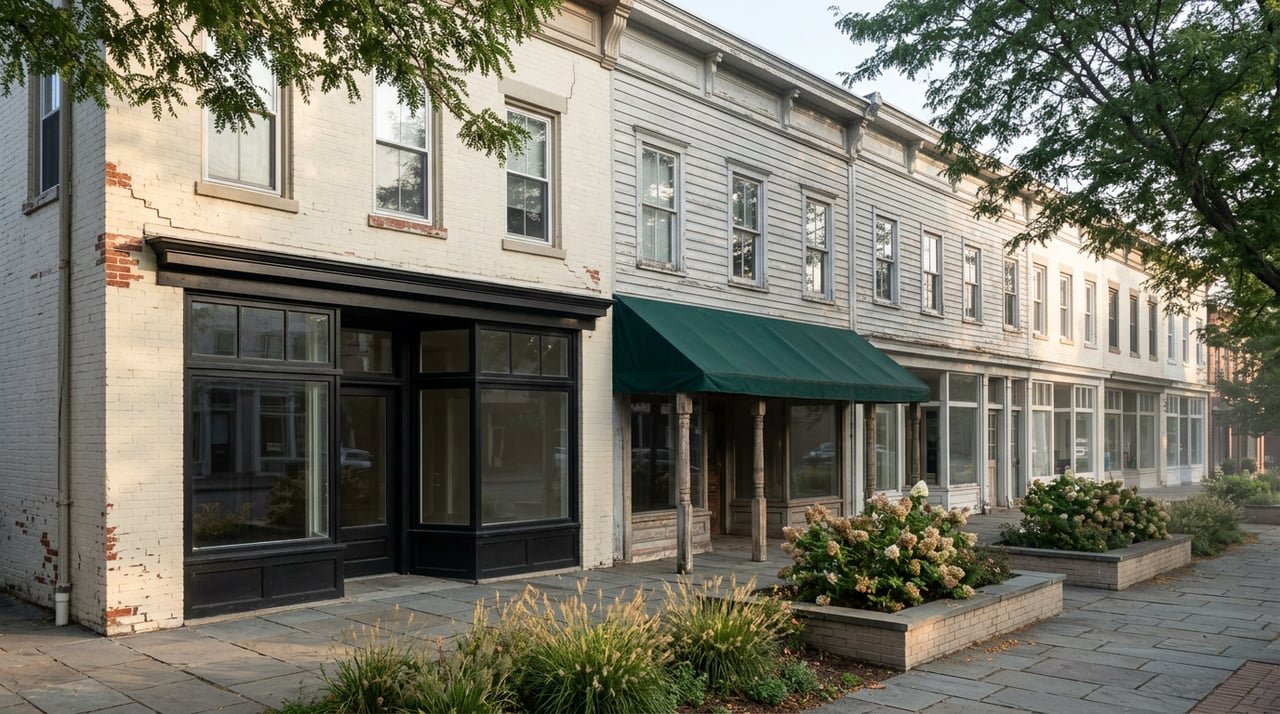
Most river towns organize themselves around a loop: a Main Street that curves back on itself, so a walk to get coffee and a walk to see the water are two separate outings. Tivoli doesn't work that way. Broadway, the village's only real commercial street, runs in a straight line downhill from the center of town to the old train tracks at the Hudson's edge, a run of about a mile and a half with no turn required. The businesses cluster at the top. The river sits at the bottom. Everything in between is the same street.
That single fact changes what a normal week in Tivoli actually looks like, and it's the reason a village this small supports as many restaurants, a wine shop, a bakery, an ice cream counter, and an art gallery within a few blocks of each other. You're not driving to a commercial strip and then driving somewhere else for the water. You're walking one line, and the line does both jobs.
One Street, Not Two Errands
Ask someone who just moved here to describe Tivoli's layout and they'll usually get it wrong at first, picturing a grid or a cluster of streets the way most Hudson Valley villages are built. Broadway, also signed as Route 78 as it leaves the village, doesn't behave like that. It's a single sloped corridor: business fronts near the top, a residential stretch through the middle, and then a straight downhill run to the river and the old rail line, roughly 1.6 miles from the center of the village to the water.
That means the walk you'd take to grab dinner is the same walk, extended, that gets you to the Hudson. There's no separate trip to "go see the river." You just keep going. Near the top of the hill, where Bard College's campus paths begin, the route eventually connects into the trail network behind campus that loops back toward Blithewood, the college's historic riverfront garden overlooking the Catskills. Someone who wanted to walk from the village center all the way to Blithewood could do it, on foot, as a single continuous route of a little under three miles one way.
For a resident, that's not a tourist fact. It's a practical one. It means errands and the river are not competing uses of an evening. They're the same use.
What's Actually There Right Now
The top of Broadway is where the density lives, and it's worth being specific about what's actually on that stretch, because the businesses sit closer together than the map suggests.
| Business | Address | What it's for |
|---|---|---|
| GioBatta Alimentari | 69 Broadway | Italian dinner and provisions, run by chef Francesco Buitoni |
| Tivoli Wine & Spirit | 65 Broadway | Wine and spirits |
| Club Sandwich | 76 Broadway | Daytime café and neighborhood market |
| Tivoli General | 54A Broadway | Coffee, sandwiches, café hours Wednesday through Sunday |
| Tivoli Arts | 60 Broadway | Gallery and performance space |
| Traghaven Whiskey Pub & Co | Broadway | Pub |
| Santa Fe Restaurant | Broadway | Long-running Mexican and Southwestern kitchen |
| Osaka | Broadway | Japanese restaurant |
| Broadway Pizza | Broadway | Pizza |
| The Corner | at Hotel Tivoli | Mediterranean and American, breakfast through dinner |
| Rojo Tapas and Wine | Broadway | Tapas and wine bar |
That's eleven storefronts inside a stretch you can walk in under ten minutes, which is a different kind of density than "there are restaurants in town." It's closer to the way a single city block works: you decide what you want by walking past three or four options, not by driving between them.
The Turnover That Isn't Really Turnover
Villages this size get read as either frozen in time or constantly changing, and Tivoli's Broadway is neither. Tivoli Mercantile, the jewelry shop that operated at 60 Broadway, has closed. Club Sandwich, the café and market at 76 Broadway, opened its doors on April 3, 2025, the work of hospitality veteran Anna Morris and Fortunes Ice Cream owner Lisa Farjam. The two had met years earlier when Farjam rolled her ice cream cart up to Kitty's in Hudson, where Morris was working as general manager at the time, and when a space opened down the street from Fortunes, Farjam called Morris and the two built Club Sandwich together.
That's the pattern worth noticing. The names that show up on Broadway tend to already know each other, or already know the street. Francesco Buitoni, the chef behind GioBatta Alimentari, built his following at Mercato in Red Hook before bringing that same following to Tivoli, and regulars will tell you they followed him from one address to the other. When a storefront changes hands here, it's rarely a stranger walking in cold. It's someone already circulating through the same small network of restaurants and markets between Tivoli and its neighbors.
For a resident, that matters more than whether the total business count goes up or down in a given year. It means the character of the street tends to hold even as specific storefronts turn over, because the same small set of people, recipes, and relationships keep resurfacing under new names.
Where The Downhill Actually Takes You
Keep walking past the last storefront and Broadway empties out fast. The road drops toward the Hudson and the old rail line, and the character of the walk changes from village to open water within a few minutes. This is also where the route can branch, because just north and south of the village, the state maintains public access into the Tivoli Bays Wildlife Management Area, one of the healthiest examples of tidal swamp left in the Hudson River estuary.
The two main entry points are the Kidd Lane trailhead, reached off Route 9G just south of the village, and the Cruger Island Road access, which leads to the North and South Bay trails. Bard College's own trail map describes the South Tivoli Bay trail as a two-mile stretch through tidal lowlands and wooded uplands, rated moderate and suitable for all skill levels, which is the same trail that eventually connects to the Sawkill stream and its waterfall on campus, a spot Bard's own trail guides point to as one of the more rewarding short walks on the property.
A few practical notes worth knowing before you go. Parts of the Cruger Island access have seasonal restrictions tied to nesting wildlife, so it's worth checking current signage at the trailhead before planning a walk out to the island itself. Ticks are a real presence in the tall grass sections of the bays, and the standard precautions, repellent, staying on marked trail, and a check afterward, apply here the way they do anywhere in this part of the Hudson Valley. None of this makes the trails less worth using. It just means the walk down from Broadway rewards a little planning depending on the season.
The Shape Of A Tivoli Day
Put those two halves together and you get something that's easy to describe and a little unusual to actually live inside. A resident here doesn't drive to a commercial district for dinner and separately drive to a trailhead for a walk. Both errands sit on the same street, in the same direction, one continuous line from the wine shop to the water. The village center holds enough restaurants and small shops that you rarely need to leave it for a normal week, and the same walk that runs those errands keeps going, past the last storefront, down through open fields, and into a tidal marsh that the state has spent decades protecting.
That's not a claim about Tivoli being scenic, which is true of a lot of towns along this stretch of river. It's a claim about how the geography actually organizes a day here. The street works. It just doesn't loop.
If you're already living this rhythm and starting to think about what a move within it, or out of it, might look like, Melissa Dubin has spent her career in these towns and can talk through what a change actually means for your specific stretch of road.